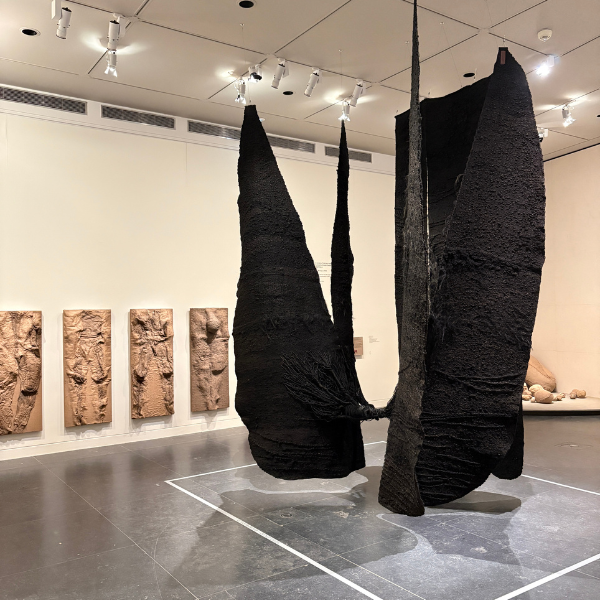
The exhibition of Magdalena Abakanowicz at the Bourdelle Museum was a true discovery for me a shock. Abakanowicz’s organic textile work, like that of Louise Bourgeois, does not seek to please but to probe the depths of the psyche and the traumas of history.
Her Abakans immense structures of sisal and rope suspended in space act as totemic presences. One wanders among these oversized skins, these fabrics of life that seem torn from the earth itself. There is something obsessive in the red, black, or ochre matter, which evokes organs as much as primitive architectures. One feels the same urgency, the same inner necessity found in Bourgeois’s work: the need to give form to isolation, but also to an extraordinary force of resilience.
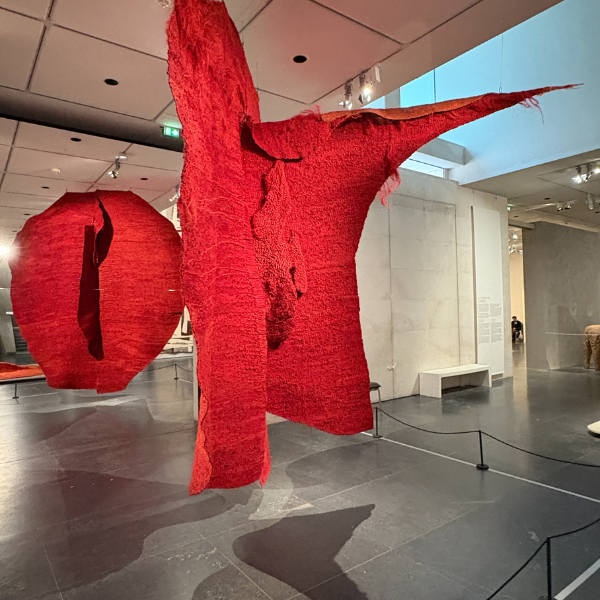
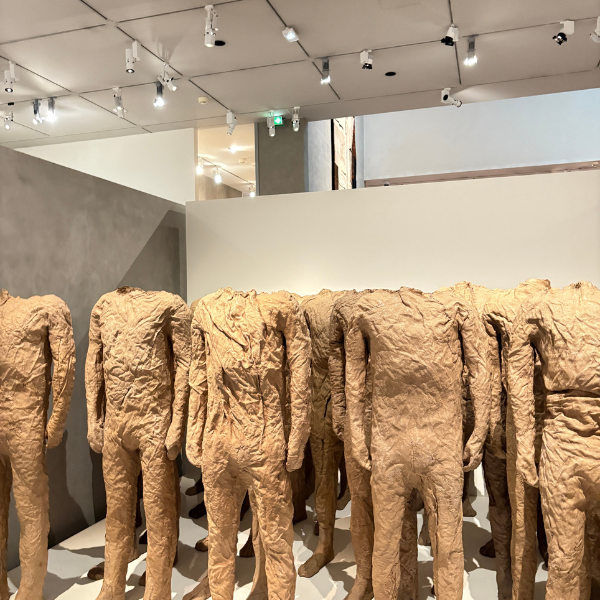
It is an exhibition that celebrates the notion of the “weave” both literally and figuratively: weaving as a social bond, but also as a trap or a form of protection. Far from being solely dark, Abakanowicz’s work is an ode to metamorphosis. The roughness of the textile, its smell of dust and earth, brings us back to a forgotten tactile reality, while the lightness of her works on paper reminds us that fragility, too, can be a source of strength.
One leaves the exhibition with the feeling of having crossed a mental landscape of rare intensity, where every knot and every tear tells the story of a woman’s struggle to exist in a fragmented world. It is a masterful retrospective, a celebration of living matter that continues to resonate within us long after we have left the sculptor’s studios.
If you’d like, I can smooth this into a more critical/art-historical tone, or heighten the poetic charge even further.