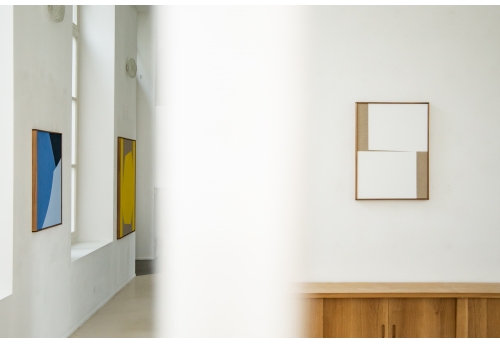
Introduction to the exhibition catalog “In perspective” (En perspective) at Amélie Maison d’Art Paris, written by Pierre Wat, art historian
Shape: A set of characteristic traits that allow a concrete or abstract reality to be recognized, say the dictionaries. Recognized, in other words distinguished from other forms as from the background on which it appears, from which separates this boundary which in painting is called contour.
Ludovic Philippon is a painter. His art does not obey definitions: he foils them. For pleasure because the freedom to paint resides, precisely, in this ability to escape the recognizable to make the painting the place of a fruitful astray. To stand in front of a painting by Ludovic Philippon is to accept to give up the illusion, at first tried, that what is there can be named, identified, recognized. What I took for a floral motif, is it something other than a white space, expanding, on an orange background? But, by the way, what is orange or white? Orange Sweetness, the title tells us. We are far from dictionaries and their cold definitions. We are at the heart of painting: what it, when it plays on the limits that freeze the visible, gives to experience.
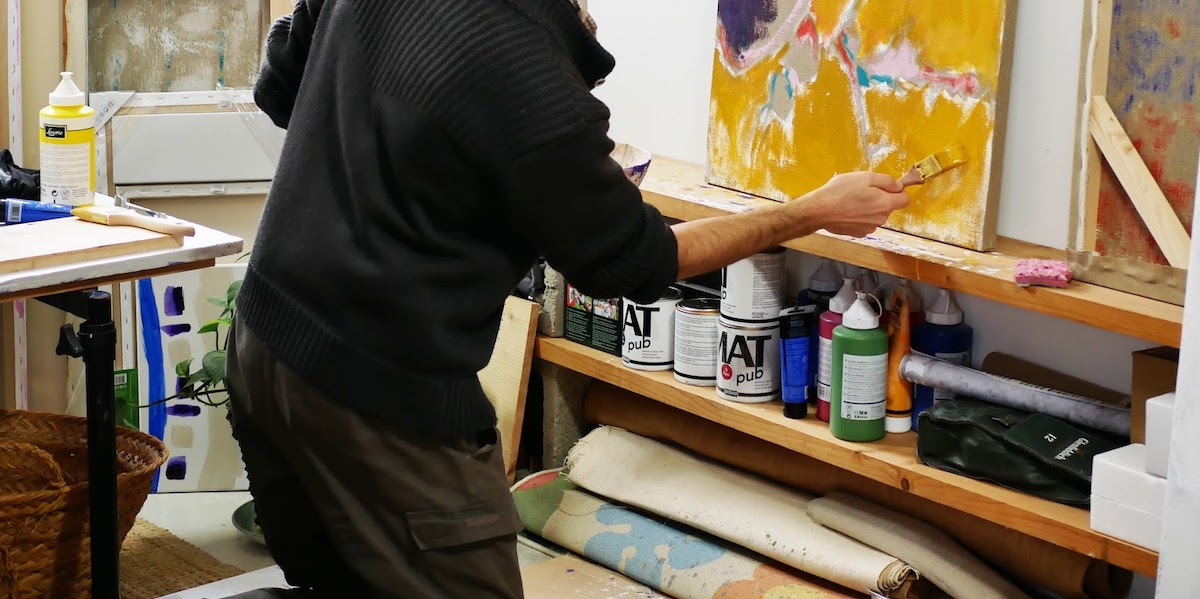
Pleasure and necessity because for the artist, who was an architect for a long time, it is a question, through painting, of inventing another space, an open space, not obeying either the definitions of dictionaries or the stifling rules of construction. No form exists in him without its counterpart, with which it maintains impure relations, not of separation, but of hybridization. This is the opening: this way, each time reinvented, to seize everything that could make a contour, to transform it into a breach. The painting is a break-in. Something happens. This is called space and this birth that the painter gives us to live takes the form of a rift - and of an alliance. In Orange Sweetness it is impossible to know who, orange or white, comes, by intrusion or expansion, into the space of the other. But what’s the point of slicing when paint gives us the opportunity to stand there, facing the undecidable?
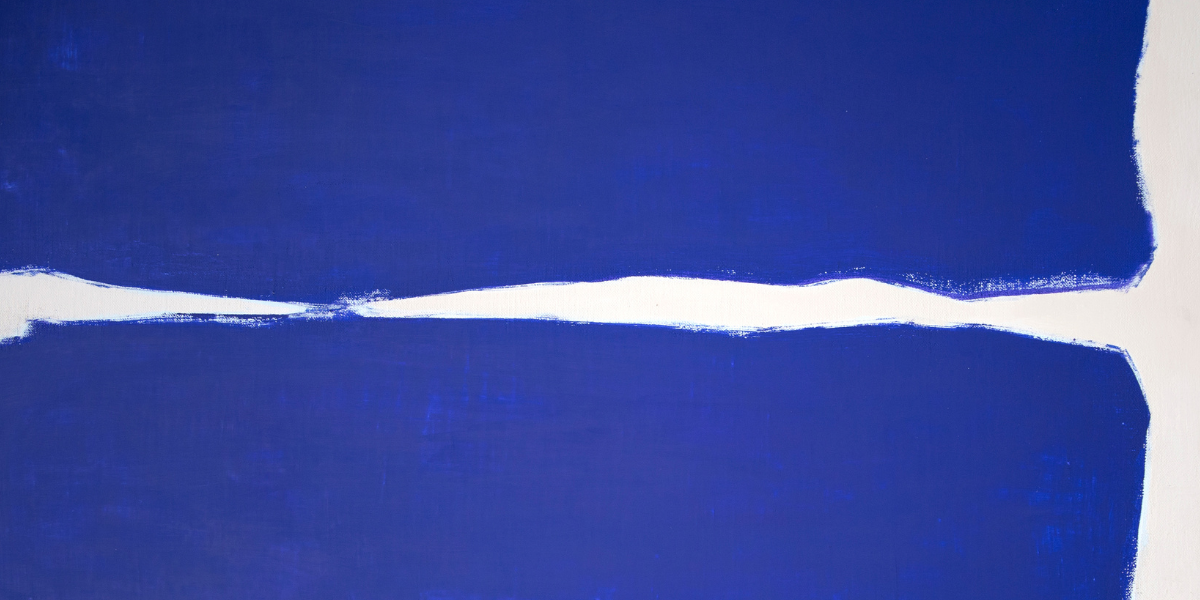
Giving up recognizing opens your eyes. As soon as I no longer look for the boundaries that separate me, I see that here everything that could make a border is really a crossing. No line is drawn with a line because it is a hand, human, hesitant, carried by painting as a lived experience in the present, which traces this (Hush II). No edge is truly edge, or limit, because where something should stop, at its margin even something else appears, like a below coming to work the above (Great Dark Balance). Painting is a path. Everything that took place in the time of this painting is still there, even what we no longer see, even what we barely see, which is still working, as a memory that our gaze awakens. “I don’t stop, when I paint, adding things that aren’t there,” Philippon said. Beautiful formulation even in its enigmatic character. Painting is adding hidden. The painting is an active, expanding space, saturated with an invisible that, like a force, beats in breach what contains it, in order to reach the open.
Born in 1973 in Rochefort sur Mer, France. Lives and works in Quissac in the Gard region.
Graduated from ENSA Montpellier, architect DPLG in 1999. Subject of the final thesis, La cabane, poetic of the entanglement, reflection on time, space and "inhabited", Jean Leccia, painter and director of study.
Advanced Studies Diploma "Social Links-Symbolic Links", philosophy-psychoanalysis option, at the UPV (Montpellier III) in 2004, thesis: repetition in the unconscious, study director Bernard Salignon, professor of aesthetics.
Freelance architect from 2006 to 2020.
PERSONAL EXHIBITIONS:
2022
"Breath of Colours", AMDesigns, Anvers.
"Entre-Deux", Les Vignes Buissonnières, Valflaunès.
2021
"Ecrire l'Espace", Amélie Maison d'Art, Paris.
2019 "En Perspective", Amélie Maison d'Art, Paris.
2017 "Autour de la vigne" in the vineyard of Aigues Belles in France