
In the context of the Olympic Games and the UEFA Cup, we invite you to revisit various sports masterpieces!
Among these works, Nicolas de Staël captured the essence of an ordinary football match. On a large canvas, his colorful strokes, rapidly thrown onto the grass, convey all the intensity of the match he observed.
In the headline of the newspaper "L’Équipe" on Thursday, March 27, 1952, one could read: "Large crowd, but disappointing game on the international level, last night at the Park." The only noteworthy fact being that this match was played for the first time at night. Although this match did not make a mark in the history of French football, it left an imprint in the history of art. This event indeed gave birth to what may be Nicolas de Staël's masterpiece, and certainly one of the great works of the 20th century: "Parc des Princes."
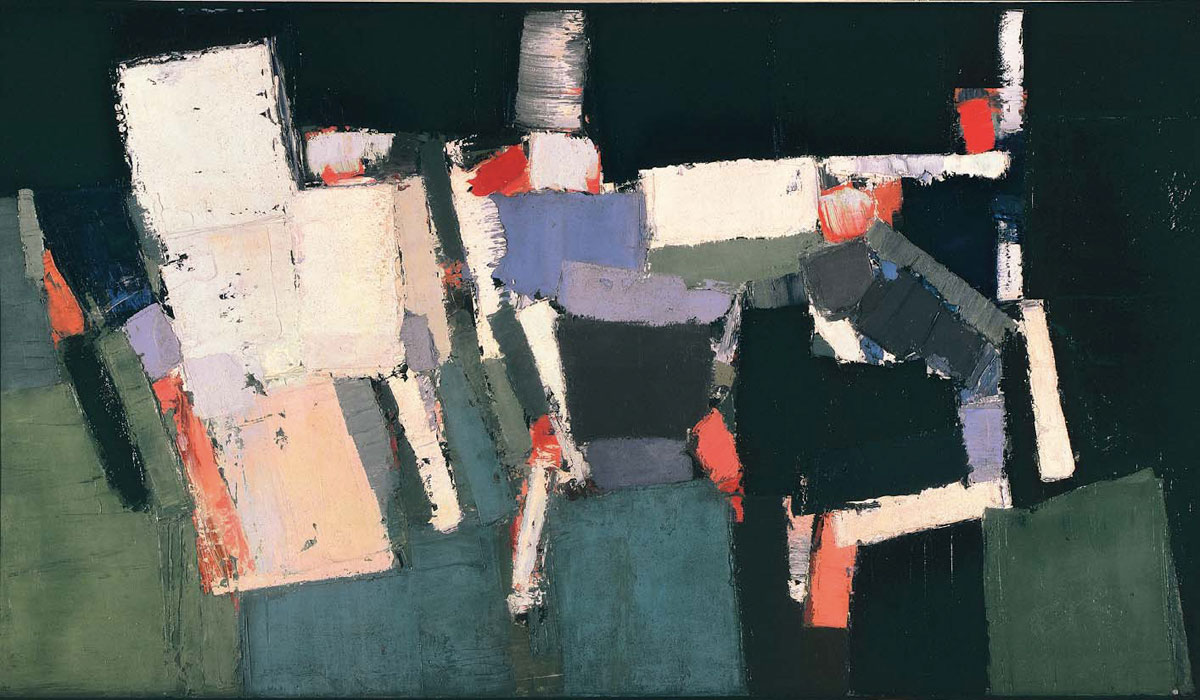
To create this vast composition, Staël used a new tool, a cut-out piece of sheet metal, in addition to his usual spatulas. The sheet enables him to spread out large expanses of creamy color, separated from one another by "seams". The painting is illuminated by rich whites, sometimes warmed by a touch of ochre pink, sometimes tinged with blue. Here, the colorist's art reaches its apogee. The multiplication of oblique lines gives the composition a formidable dynamism, expressing all the power of the live match. Long matured through earlier works, this canvas is a masterpiece of concentrated energy.
With this painting, Nicolas de Staël puts an end to the dichotomy between figuration and abstraction. "Painting shouldn't just be a wall on a wall," he declares, rejecting the opposition between abstraction and figuration: "A painting should be both abstract and figurative. Abstract as a wall, figurative as a representation of space."